.svg)
.svg)
.svg)
Of all the questions independent pharmacy owners ask about automation, one comes up more than any other, and it has nothing to do with speed or price. It is some version of: how do I see what it actually did?
The Pharmacy Automation Question Owners Ask First
The question takes a few shapes. An owner wants to know what ran while the pharmacy was closed: which prescriptions were picked up, which were finished, which were set aside. A pharmacist wants to know how a specific decision was reached before signing off on it. And a technician, often the most experienced one on staff, wants to look at the work with folded arms and check whether the robot got it right.
Those are three good instincts, and they point at the same thing. Automation that does the work but cannot show the work leaves the owner guessing, leaves the technician suspicious, and leaves the pharmacist approving something they cannot inspect. Back in June we wrote that the AI you choose has to earn your team's trust, not just yours. This is the part of that argument we didn't spell out: trust is earned by being inspectable.
Why Pharmacy Automation Has to Show Its Work
When a technician makes an entry error, you cannot see what they were thinking. You see the result, you ask, and you get a reconstruction. That is the normal condition of human work, and pharmacies have built their whole verification process around it.
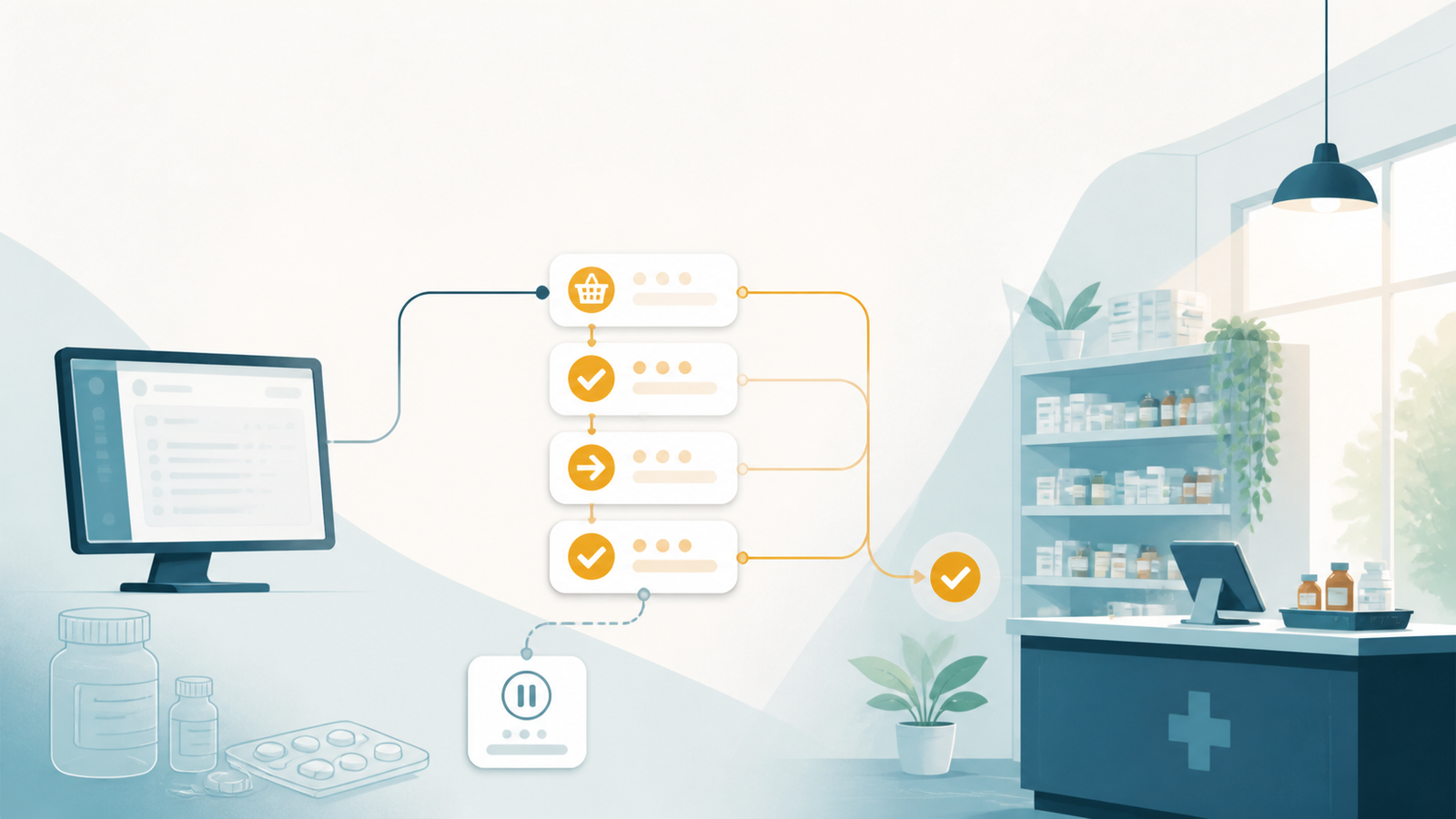
Automation does not have to inherit that limitation. Every action an AI Technician takes can be logged as it happens, along with the logic it applied: which prescription it picked up, what it read on the screen, which rule it matched, what it entered, and where it stopped. Read in order, that log is a complete account of the run. Nothing has to be reconstructed.
This matters more in pharmacy than almost anywhere else, because the pharmacist carries the legal responsibility for every dispensing decision. Pharmacist review is the compliance requirement, and it only works if there is something inspectable to review. A log that says "done" is not enough. The pharmacist needs to see what was done and why.
It also matters to the people watching over the automation's shoulder. The skeptical technician is the best quality assurance a pilot has. Give them the log, let them look for the mistake, and one of two things happens: they find one, and the task logic gets adjusted, or they don't, and trust gets built on evidence instead of assurances. Either outcome is a win. The rollouts that stall are the ones where the doubters have nothing to inspect.
What a Real Audit Trail Looks Like
PAT (Pharmacy AI Technician) is a governed AI Technician that drives a pharmacy management system through the screen over an encrypted tunnel, with no API required, nothing new installed at the pharmacy, and the pharmacist in the loop on every clinical decision. Every action it takes is logged, including the logic it applied.
In practice, the morning after an overnight run, an owner or pharmacist can see four things without asking anyone.
Everything that was attempted. Each prescription in the queue, in order, with what PAT read on the screen and what it entered.
Everything that was completed. The full path from pickup to done, step by step, so a pharmacist can verify a specific script by reading its trail rather than re-entering it.
Everything that was skipped, and why. When PAT meets something its task logic does not cover, it skips that item, keeps the rest of the queue moving, and records the reason. The notification carries no patient information. The pharmacist decides what happens next, and the logic is then extended to cover the case. (We covered how unmonitored automation loses scripts in Bots Are Not AI Agents; the audit trail is what makes that failure visible instead of silent.)
Where the automation worked. PAT works in dedicated queues set up for it inside the pharmacy management system. It never touches the queues your staff are working from. So the log is also a boundary: the technician can see exactly which work belonged to PAT and which belonged to the team.
The task logic itself is written in plain English and is readable by pharmacy staff, so when the log shows a rule being applied, the rule is something a technician can read and challenge. Where the logic drifts from how the pharmacy actually works, that is a conversation between the pharmacy and Sonet, and the change is included, not billed.
Ask for the Log Before You Ask for the Number
If you are evaluating automation for your pharmacy, a useful habit: before you ask how many prescriptions it can process, ask to see what it did. Volume is easy to quote and hard to check. The log is the opposite.
Then set one concrete goal for the pilot, written down and shared with the team: which workflow, roughly how many per day, by when. A pilot with a number is a pilot the whole team can judge. A pilot without one drifts.
And hand the log to your most skeptical technician first. If the automation survives that review, it has earned the next workflow. If it doesn't, you found out in a pilot instead of in production.
Regulators are asking the same question owners are. The NABP's 2024 to 2025 Presidential Initiative on AI governance was launched to help state boards of pharmacy evaluate AI tools against public health and safety standards, and state boards are beginning to ask automation vendors to explain how their tools work and where the pharmacist stays in control. An automation vendor that welcomes that conversation is one worth talking to. One that avoids it is telling you something.
See the step-by-step mechanics of how PAT works an e-prescription and refill queue, including the log, in the PAT Solution Brief, or see how PAT works in a pharmacy.
Frequently Asked Questions
Can I see what PAT did overnight?
Yes. Every action PAT takes is logged as it happens, along with the logic it applied: what it read on the screen, which task rule it matched, what it entered, and where it stopped. The log covers completed work, skipped items with the reason, and the order everything ran in.
What happens when PAT skips a prescription?
It records the reason, leaves that item for the pharmacist, and keeps working the rest of the queue. The notification contains no patient information. The task logic is then extended to cover the case so it is handled next time.
Does PAT work in the same queues as my technicians?
No. PAT works in dedicated queues set up for it inside the pharmacy management system. Staff queues are untouched, and the log shows exactly which work was PAT's.
Does the pharmacist still review PAT's work?
Yes. The pharmacist stays in the loop on every clinical decision. That is the compliance requirement under current pharmacy AI guidance, and the audit trail exists so that review is based on the full record of what PAT did rather than on a summary.
.svg)